The Central Asian delegation visited Shandong Huagong Bearing Co., Ltd. for inspection and exchange
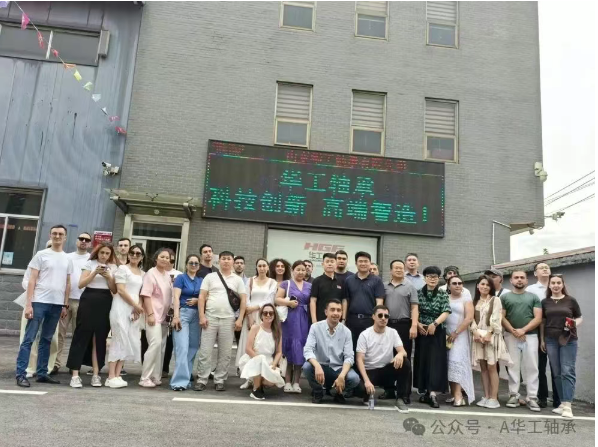
On the afternoon of June 18th, a Central Asian delegation consisting of six countries including Azerbaijan, Armenia, Kazakhstan, Kyrgyzstan, Tajikistan, and Uzbekistan came to the tobacco shop for inspection and exchange on the development of bearing industry trade. Feng Tianhui from the Foreign Trade Department of Liaocheng Commerce Bureau and Han Meiyan, the head of the Foreign Trade Department of Linqing Commerce and Investment Promotion Bureau, participated in the event. Liu Qihui, Deputy Secretary of the Party Committee of Yandian Town and Director of the Liaison Office of CPPCC Members, Niu Shikang, President of Linqing Bearing Import and Export Trade Promotion Association, and representatives of enterprise members of the trade promotion association accompanied the event.
The delegation went deep into Shandong Huagong Bearing Co., Ltd. to visit the modern intelligent workshop and closely observe the production scene of the entire bearing chain: from the strict control of product quality by high-precision detection equipment, to the efficient operation of automated assembly lines, and to the precise scheduling of intelligent warehousing systems, each link demonstrated the "hardcore strength" of China's bearing manufacturing. The members of the inspection team frequently stopped to exchange ideas and praised the technical processes, quality control standards, and industrial scale of Huagong bearings. They stated that their innovation level and production efficiency were impressive, setting a benchmark for international bearing cooperation.The visit has built a bridge for practical cooperation between Central Asian countries and the cigarette store bearing industry. The two sides have carried out in-depth discussions around technology sharing, market expansion, supply chain coordination and other issues, and jointly seek new opportunities for bearing trade under the framework of the "the Belt and Road". In the future, all parties will use industrial docking as a link to promote resource complementarity and mutual benefit, injecting new momentum into regional economic integration.